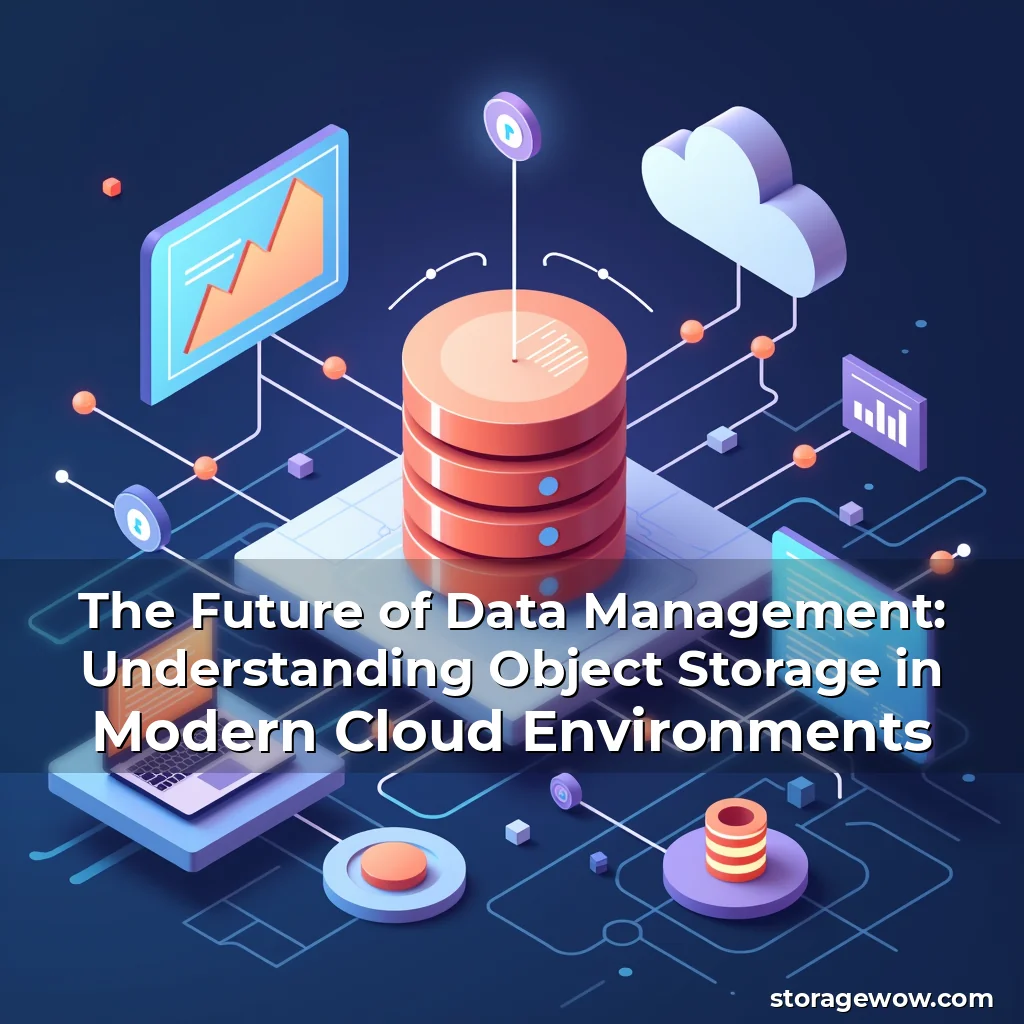
The Future of Data Management: Understanding Object Storage in Modern Cloud Environments
In an era where data is the new oil, traditional file systems are struggling to keep up with the exponential growth of unstructured data. As enterprises generate terabytes of information daily from IoT devices, social media interactions, and video streams, conventional hierarchical structures fail to deliver scalable solutions.
Object storage has emerged as a revolutionary approach that redefines how we store, manage, and retrieve vast amounts of digital assets. This paradigm shift not only addresses scalability issues but also introduces innovative features tailored for modern cloud infrastructure needs.
Redefining Traditional File Systems
Traditional file systems organize data using directories and subdirectories within a tree-like structure. While effective for smaller datasets, they become inefficient when handling petabyte-scale operations due to limitations in metadata management and access speed.
The hierarchical nature of these systems often leads to performance bottlenecks during high-throughput scenarios. As organizations expand their digital footprints across global networks, maintaining consistency becomes increasingly complex without robust alternatives.
- Metadata Overhead: File-based systems require extensive metadata tracking which consumes significant system resources.
- Access Latency: Hierarchical traversal times increase dramatically with larger dataset sizes, affecting overall operational efficiency.
What Exactly Is Object Storage?
Object storage treats each piece of data as a distinct entity called an object rather than grouping them under directory hierarchies. Each object contains both the actual data payload and associated metadata within its own container known as a bucket.
This architecture enables seamless scaling by allowing independent expansion of storage capacity while maintaining uniformity through consistent interfaces. Unlike block or file storage models, there’s no need for predefined volume limits or fixed allocation patterns.
Core Components of Object Storage Architecture
An object consists primarily of three fundamental elements: the data itself, descriptive metadata, and a globally unique identifier (UID). These components work together to facilitate efficient retrieval and management processes across distributed environments.
The UID ensures that every stored item can be accessed precisely regardless of location. Metadata provides contextual information such as creation date, owner details, and access permissions, enhancing security and usability aspects significantly.
Buckets act as containers holding collections of objects along with access control policies defining who can view or modify contents inside them. They support versioning capabilities crucial for audit trails and disaster recovery scenarios.
Why Choose Object Storage over Other Models
Selecting between different types of storage solutions depends largely on organizational requirements and use cases. Block storage excels at providing low-latency random access suitable for databases whereas file storage offers familiar folder navigation experiences ideal for shared drives.
However, neither model scales efficiently beyond certain thresholds without substantial overheads related to maintenance costs and complexity levels. Object storage resolves these challenges through horizontal scalability achieved via commodity hardware deployments combined with intelligent software layers.
- Scalability: Supports virtually unlimited growth by adding nodes instead of upgrading existing ones.
- Cost Efficiency: Utilizes cheaper disk arrays compared to specialized SAN/NAS appliances reducing total cost of ownership.
Use Cases Driving Adoption Trends
Content delivery networks rely heavily on object storage to distribute static assets quickly around the globe minimizing latency concerns for end users accessing web pages or streaming services simultaneously from various locations.
Data lakes built upon object storage platforms enable organizations to aggregate raw structured/unstructured data sets from diverse sources creating unified repositories ready for advanced analytics processing tasks later.
Backup & archival strategies benefit immensely from object storage’s durability characteristics since data remains accessible even after prolonged periods without requiring frequent migration efforts typically demanded by other methods.
Security Considerations in Object Storage Implementations
Safeguarding sensitive enterprise information requires implementing multi-layered defense mechanisms starting right at the design phase itself. Access controls must restrict unauthorized modifications ensuring integrity preservation throughout lifecycle stages.
Encryption protocols applied both at rest and transit add another level of protection against potential breaches attempting to intercept transmitted files or exploit vulnerabilities present within underlying infrastructures.
- Role-Based Access Control (RBAC): Assigns permissions based on user roles limiting exposure risks effectively.
- Data Encryption Standards: AES-256 encryption standards commonly employed guarantee strong confidentiality assurance measures.
Performance Optimization Techniques
To maximize throughput rates during peak load conditions, administrators employ caching techniques strategically placing frequently accessed items closer to application tiers reducing round trip delays considerably.
Distributed computing frameworks leverage parallelism advantages inherent in cloud-native architectures enabling simultaneous processing activities across geographically dispersed clusters thereby improving response times substantially.
Tiered storage approaches classify data according to frequency usage patterns storing hot data on faster SSDs while cold archives reside on slower HDD configurations optimizing resource utilization dynamically.
Evolving Landscape of Object Storage Technologies
Advancements continue shaping next-generation object storage offerings incorporating machine learning algorithms capable of predicting failure points before they occur thus preventing service disruptions proactively.
Integration with blockchain technologies enhances trustworthiness attributes verifying authenticity credentials automatically whenever transactions take place preserving immutability properties essential for compliance purposes.
Edge computing paradigms now extend object storage capabilities closer towards source generation sites facilitating real-time decision making functions without relying solely on centralized data centers anymore.
Industry Leaders Shaping Object Storage Ecosystem
AWS S3 remains dominant among public cloud providers offering extensive feature sets including cross-region replication, lifecycle policies, and integrated IAM tools simplifying administrative workflows significantly.
Google Cloud Storage distinguishes itself through flexible pricing options catering specifically towards developers needing affordable yet powerful storage backends supporting multiple APIs out-of-the-box seamlessly.
Microsoft Azure Blob Storage complements hybrid deployment strategies well leveraging Active Directory integration alongside rich monitoring dashboards providing granular visibility into operational metrics continuously.
Emerging Challenges Facing Object Storage Growth
Despite numerous benefits, some technical hurdles persist concerning interoperability issues arising when migrating legacy applications designed originally for POSIX-compliant environments onto newer object-oriented platforms.
Complexity increases notably when managing heterogeneous ecosystems combining disparate storage silos requiring additional middleware abstraction layers increasing implementation timelines unnecessarily.
Vendors occasionally introduce proprietary extensions deviating slightly from standard RESTful API specifications potentially leading to vendor lock-in situations restricting future flexibility choices unfavorably.
Frequently Asked Questions About Object Storage
Q: How does object storage differ from NAS/SAN setups?
A: Object storage diverges fundamentally by abstracting away physical device details treating everything as self-contained units versus relying on network attached storage devices connected via Ethernet cables or fiber channels used traditionally.
Q: Can object storage handle structured database records effectively?
A: While technically possible, it’s generally less optimal because relational databases demand precise indexing schemes better supported by traditional row-column formats rather than flat file representations favored here.
Q: What backup methodologies apply best practices to object storage instances?
A: Regular snapshots coupled with offsite copies maintained separately ensure redundancy coverage necessary especially considering long-term retention obligations mandated legally sometimes.
Conclusion
Object storage represents a transformative leap forward addressing contemporary demands imposed by ever-expanding digital landscapes prevalent today. Its ability to scale effortlessly combined with enhanced security features makes it indispensable across varied industries ranging from entertainment sectors producing massive multimedia libraries down to healthcare institutions safeguarding critical patient records securely.
As businesses transition further toward digitization initiatives embracing cloud-first mindsets, adopting object storage solutions proves not merely beneficial but absolutely essential for sustaining competitive advantage amidst rapidly evolving technological advancements continually reshaping our world.